
PraxisPoetica VIII. Step 5. Let's roll out the whole flow and Kanban Board of Process and Artifacts from the Premise

Yep. We forgot the Vision Document. And, more importantly, we forgot the flow, the rolling out from the Premise through the whole process. We forgot the benefits of the view from 30,000 feet. In both senses of the words. Last night I had, figuratively speaking, all of the digital artifacts I’ve already completed (well, except the manuscript) spread out on the floor and there seemed to be repetitions, conflicts, maybe superfluous elements… hmmm, what was that about conflict leading to change?
Talk about thesis-antithesis-synthesis broken
Section titled “Talk about thesis-antithesis-synthesis broken”(Initial) Artifacts for DTAD-WITPL (Series Denying the Amerikan Dream. Wandering into the Promised Land)
Section titled “(Initial) Artifacts for DTAD-WITPL (Series Denying the Amerikan Dream. Wandering into the Promised Land)”- For Wandering into the Promised Land, our Story Blueprint consists of the following, in order of initial creation (all are, of course, iterative and incremental, except that once the scenes are being written we don’t want to be changing the cause-and-effect trajectory, whether Jennie Nash’s Inside Outline or Lisa Cron’s Story Cards in Development).
Artifact sources and listing reference used here
| Lajos Egri | Lisa Cron | Jennie Nash | Section | Observations |
|---|---|---|---|---|
| Inspiration | Spark | 01 Premise | ||
| Strong conviction regarding Premise Strong desire to prove Premise | Motivation (Why do you care?) | Why Write This Book (Step #1) | 01 Premise | |
| Premise | Point | Point (Step #2) | 01 Premise | Jennie Nash same as Lajos Egri: character + conflict + conclusion |
| Synopsis | What If? | 3-4 Sentence Super Simple Version of Story A very short and super simple description (Step #3) | 01 Premise | What If? deals with inciting incident, but not the ending, or conclusion Jennie Nash same as Lajos Egri, where the short description of the story emerges naturally from the Point (premise) |
| Pivotal Character | Protagonist | Who is your Protagonist (Step #8) | 02 Pivotal Character | |
| Character, Orchestration | Layering: Storylines (Character Arcs) | 03 CharactersAndOrchestraton | ||
| Story Blueprint | Story Blueprint | Story Blueprint | 04 StoryBlueprint | See PraxisPoetica VI. Step 3. The Novel Blueprint especially the section Complete Set of All Blueprint Artifacts That covers Lajos Egri and Lisa Cron; here we will add many of Jennie Nash process artifacts along the way |
| Scenes | Scenes | Scenes | 10 Manuscript | Bash Shell Scripts exist for concatenating Parts (concatenated markdown for Astro) as well as the complete Manuscript (in markdown, but easily exportable to docx for formatting in Atticus either via pandoc itself or Obsidian export plugin (installed: right-click on manuscript markdown file)) |
And that’s just the tip of the iceberg.
Search for synthesis, not formal logic
Section titled “Search for synthesis, not formal logic”I had a dream. So, to make a long story short, when I woke up this morning, I saw “in my mind’s eye” an imaginary photo of Lajos Egri standing on the lawn in front of his house. And next to him on the right was Lisa Cron. Both smiling of course. And then Jennie Nash appeared in the middle, between them. She took Lajos Egri’s hand, and then she took Lisa Cron’s hand. And the three of them were smiling even more now. On the lawn, in front of the house where Lajos Egri gave writing classes until the early sixties. That’s the photo.
Aha! Lajos Egri spells it out in 1946. Either directly or indirectly, Jennie Nash (going to UCLA extension classes on writing in 2000 and something)… gets it. Her examples of Premise are exactly the same as Lajos Egri’s (she calls it Point). The examples listed in her book have a similar format. More importantly she understands it in a similar fashion, as a thumbnail synopsis of the whole story driven by the protagonist in three parts (yep, character + conflict + resolution)(in plain English, the protagonist in their Transition from start to end); and Jennie Nash always says to go back to your point and expand here, expand there. And, the same as Egri, talks about knowing how your story starts and ends, and about how the first thing you have to do is know why you feel so strongly about all this as author (or else forget it), and who your Pivotal Character is. Then short description. Then start and ending. Then Inside Outline (based on Pixar Studios guidelines). Lisa Cron, smiling on the right, takes the point, the character driven approach, takes the Inside Outline and drives it up a notch to Story Cards in Development as a wonderful alternative to the mechanical application formal logic style of fixed plot pointed genre “grids”. Although, with Jennie Nash’s approach, you can if you wanna. The Story Cards in Development, however, provide a more detailed view of the flow of the story (flows right out of the Inside Outline and adds storylines, better view of protagonist transition with a clearer view of cause and effect, both in the external plot as well as internally to the protagonist’s transition through internal conflict). So the union is perfect. The photo is perfect. Jennie Nash gets it with Lajos Egri. Lisa Cron gets it with Jennie Nash (and they work together on Story Genius!).
👉 Jennie Nash takes the ball from Lajos Egri and runs as far as the short synopsis (one sentence description) and then the Inside Outline which serves as a higher view story big picture with the main transitions (the Kurt Vonnegut Story Graph). Then Lisa Cron takes the ball from Jennie Nash and fills out all the scenes, yes, all of them in development (i.e. those having won a place in the cause and effect trajectory; otherwise, out!). And Lisa Cron provides us with all the advantages of a filterable grid view: We can see a listing of all the story cards (scenes) having a given storyline, location, character arc, or all of them, what have you, filter to our heart’s content (techi: Obsidian Base and Views anyone?). Now it all flows. If you stay true to dialectics and iterative and incremental praxis (fractal (thesis - antithesis - synthesis) change) and not formal logic and rigid rules.
In the course of these PraxisPoetica Notes I’ve mentioned several writing tools, Scrivener, Plottr, Novel Factory, etc., that have templates for Story Genius. Or make your own, as I am doing in Obsidian (or Notion if you’re using that, or any PKM with a database).
Kanban Process Board please
Section titled “Kanban Process Board please”What’s a Kanban Board?
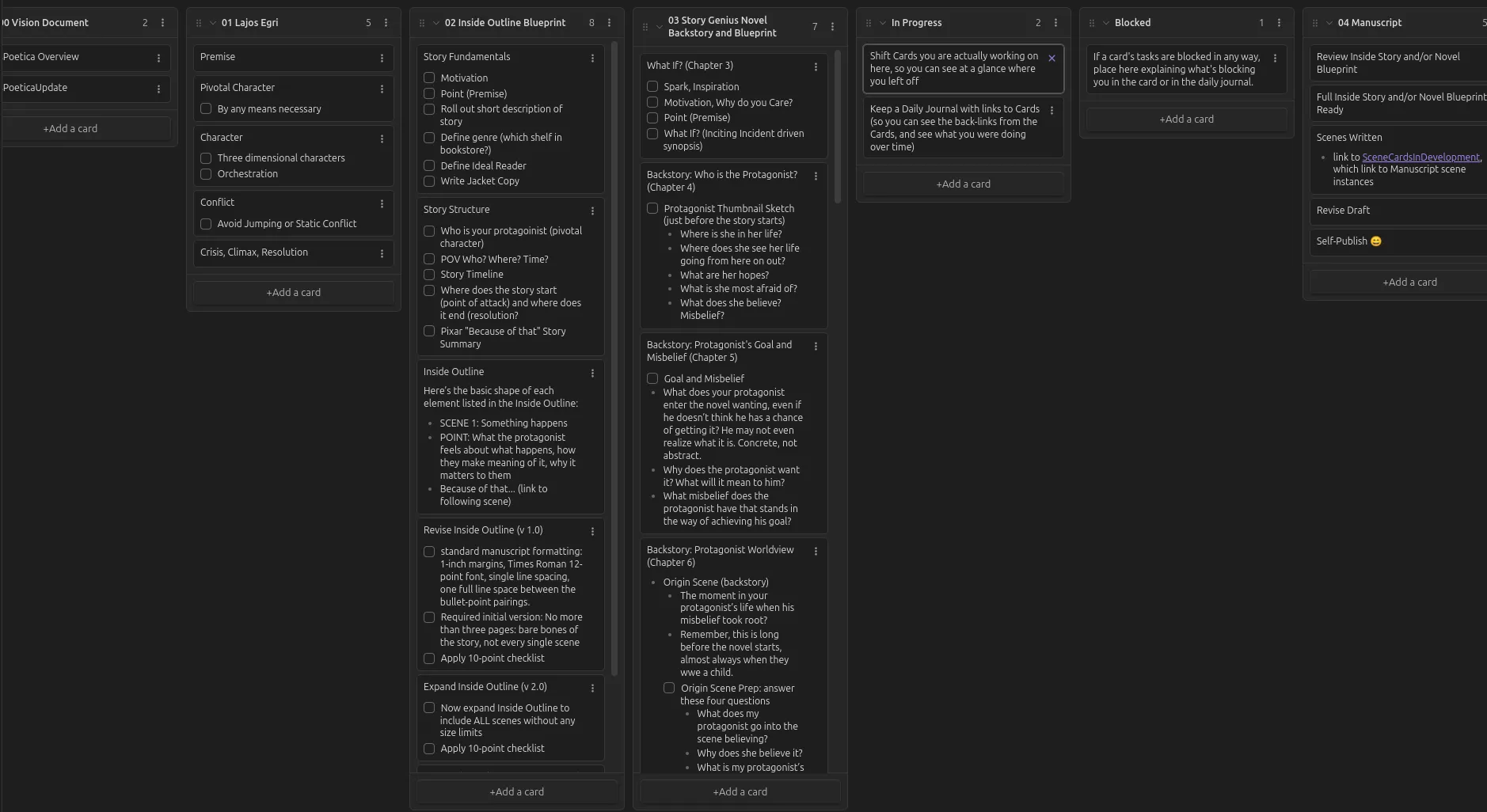
Now, instead of the ugly conflict-strewn table above (well, actually, thanks to it 😄), we have the picture that graces the cover of our PraxisPoetica Process Note today.
Here’s each column rendered as a text outline with artifacts as tasks, so you can read the cards and sub-tasks listed for each one:
00 Vision Document
Section titled “00 Vision Document”- PraxisPoetica Overview
- PraxisPoeticaUpdate
01 Lajos Egri
Section titled “01 Lajos Egri”-
Premise
-
Pivotal Character
- By any means necessary
-
Character
- Three dimensional characters
- Orchestration
-
Conflict
- Avoid Jumping or Static Conflict
-
Crisis, Climax, Resolution
02 Inside Outline Blueprint
Section titled “02 Inside Outline Blueprint”-
Story Fundamentals
- Motivation
- Point (Premise)
- Roll out short description of story
- Define genre (which shelf in bookstore?)
- Define Ideal Reader
- Write Jacket Copy
-
Story Structure
- Who is your protagoinist (pivotal character)
- POV Who? Where? Time?
- Story Timeline
- Where does the story start (point of attack) and where does it end (resolution?
- Pixar “Because of that” Story Summary
-
Inside Outline
Here’s the basic shape of each element listed in the Inside Outline:
- SCENE 1: Something happens
- POINT: What the protagonist feels about what happens, how they make meaning of it, why it matters to them
- Because of that… (link to following scene)
-
Revise Inside Outline (v 1.0)
- standard manuscript formatting: 1-inch margins, Times Roman 12-point font, single line spacing, one full line space between the bullet-point pairings.
- Required initial version: No more than three pages: bare bones of the story, not every single scene
- Apply 10-point checklist
-
Expand Inside Outline (v 2.0)
- Now expand Inside Outline to include ALL scenes without any size limits
- Apply 10-point checklist
-
Use Inside Outline to Write Forward
-
Use Inside Outline for Revision of Drafts
-
Use Inside Outline to Develop Synopses of various lengths
03 Story Genius Novel Backstory and Blueprint
Section titled “03 Story Genius Novel Backstory and Blueprint”-
What If? (Chapter 3)
- Spark, Inspiration
- Motivation, Why do you Care?
- Point (Premise)
- What If? (Inciting Incident driven synopsis)
-
Backstory: Who is the Protagonist? (Chapter 4)
- Protagonist Thumbnail Sketch (just before the story starts)
- Where is she in her life?
- Where does she see her life going from here on out?
- What are her hopes?
- What is she most afraid of?
- What does she believe? Misbelief?
- Protagonist Thumbnail Sketch (just before the story starts)
-
Backstory: Protagonist’s Goal and Misbelief (Chapter 5)
- Goal and Misbelief
- What does your protagonist enter the novel wanting, even if he doesn’t think he has a chance of getting it? He may not even realize what it is. Concrete, not abstract.
- Why does the protagonist want it? What will it mean to him?
- What misbelief does the protagonist have that stands in the way of achieving his goal?
-
Backstory: Protagonist Worldview (Chapter 6)
- Origin Scene (backstory)
- The moment in your protagonist’s life when his misbelief took root?
- Remember, this is long before the novel starts, almost always when they wwe a child.
- Origin Scene Prep: answer these four questions
- What does my protagonist go into the scene believing?
- Why does she believe it?
- What is my protagonist’s goal in the scene?
- What does my protagonist expect will happen in this scene?
- Origin Scene: Write the Origin Scene
- Origin Scene (backstory)
-
Backstory: Unlock the Plot (Chapter 7)
- The Beauty of Cause-and-Effect
- Find the rising action Crossroads/Turning Points which deepen the Protagonist’s misbelief
- Begin by envisioning your protagonist’s life from the origin scene up to the place where—for now—you imagine the novel might start in media res.
- Find at least three moments where the protagonist’s misbelief was the deciding factor in a major decision. The decision will change the external course of the protagonist’s life, upping the stakes and be part of the cause and effect that leads to the start of the novel.
- Keep an eye out for external turning points that in some fundamental way—via an intense internal conflict—cause the protagonist’s misbelief to deepen.
- Write a sketch for each of the best candidates. Your goal is to zero in on three turning point scenes that will yield the most story-specific info, the most potent grist for the mill, so that you can, indeed, begin your novel in medias res.
- Write the three or more scenes.
-
Backstory: When does the novel begin? (Chapter 8)
- Review the Crossroads/Turning Points, the ticks of the clock inevitably rising in crescendo
- What, specifically, will happen to start the chain reaction that will cause everything to happen?
- What will trigger your protagonist’s decision to take that first step out of her comfort zone?
- The good news is, your novel’s ticking clock will lead you directly to the answer. It’s simply a matter of zeroing in on that seminal tick.
- To find that seminal tick, we build on the Crossroads/Turning Points we have already sketched and written.
- Extend the list of turning point sketches until we discover the one that reaches proportions making it undeniably worthy of being the Opening Scene
- Your goal is to find the tick that catapults your protagonist into unavoidable action. When your protagonist must act and must act now.
- Keep the clock ticking until you get there. Don’t be afraid to try this again and again until you get a tick that has everything it needs—the overarching plot problem, the main ticking clock, the third rail
- When the protagonist’s internal conflict must burst into action and start the novel.
- Review the Crossroads/Turning Points, the ticks of the clock inevitably rising in crescendo
-
Novel Blueprint (Chapters 9-11)
- We’ve already mentioned in another Note that many templates for common writer tools exist.
- (See for example the template for Scrivener by Gwen Hernandez: Using Scrivener with Story Genius)
- But let’s list all artifacts required for the
Blueprintand understand together why we need them, whether we’re using a laptop or a pencil and a bound notebook. - Obviously we need one folder in our writer tool for the
Manuscript(the actualSceneinstances making up the novel our readers are going to read) - We need a folder (whether of a digital or cardboard variety) for the
Screen Cards in Development. Meaning an ordered, numbered set of Screen Cards reflecting our Cause and Effect Trajectory. Each scene card will link to the corresponding scene instance in the Manuscript. - We can have another folder,
Random Screen Cards(following the Story Genius Nomenclature, or choose your own), which will be quick idea or flash generated scene ideas that barely have at least anAlpha Point; and haven’t been assigned yet to its place on the cause-and-effect trajectory. - A
Charactersfolder holding character sketches, notes on character orchestration, and other artifacts we will soon present and explain in a forthcoming Note. - Within that folder, a
Protagonist(orPivotal Characteror whatever you wish to name it) sub-folder containing all the artifacts from our previous note PraxisPoetica V. Step 2. The Pivotal Character Who Must Win By Any Means Necessary - A
Researchfolder for notes and links to historical and/or whatever other kind of research that is needed for the novel. For this novel, social movements of the 60’s, particularly, say, the occupation of Universities as part of the movement against the War(s) in Vietnam, materials on G.I. coffeehouses, etc., as well as on many other topics. Specifically the Fort Dix 38, in Trenton, New Jersey, in which the Jewish Radical Community participated. The origins of the JRC in Los Angeles Conference for Jewish Action, May,1969, helped a lot. - A
World Buildingfolder if you feel the need for it. In the case of this novel, the hegemonies and counter-hegemonies are very much a part of (as they always are, in reality) each character. It is impossible for a character to exist without a world, and the world is not necessarily fantasy, it is the part of the character’s life without which they could not possibly exist. But if you feel the need for a folder to place all notes concerning hegemonies and counter-hegemonies, that’s fine. - An
Idea Listfor ideas that just flash into your mind in the shower, while vacuuming the floor, or out for a walk. At least you’ll know where to find them; they should be kept in one place, and associated with the work you’re doing on the novel. - Probably more stuff; later on, things related to writer tools; or publishing, like jacket covers, artwork, blurbs, whatever; events related to the launching of the novel, whatever. It’s always nice to have everything in one place.
In Progress
Section titled “In Progress”- Shift Cards you are actually working on here, so you can see at a glance where you left off
- Keep a Daily Journal with links to Cards (so you can see the back-links from the Cards, and see what you were doing over time)
Blocked
Section titled “Blocked”- If a card’s tasks are blocked in any way, place here explaining what’s blocking you in the card or in the daily journal.
04 Manuscript
Section titled “04 Manuscript”- Review Inside Story and/or Novel Blueprint
- Full Inside Story and/or Novel Blueprint Ready
- Scenes Written
- link to [[SceneCardsInDevelopment]], which link to Manuscript scene instances
- Revise Draft
- Self-Publish 😄
The Novel Blueprint and the Scene Card artifact
Section titled “The Novel Blueprint and the Scene Card artifact”The Novel Blueprint is the second part of the 03 Story Genius Novel Backstory and Blueprint column, following right after the Backstory cards and tasks. Which we have actually already covered previously:
- In an earlier Note, PraxisPoetica VI. Step 3. The Novel Blueprint the Novel Blueprint (covering Chapters 9, 10 and 11) is already dealt with in some detail.
- There is a short Scene Card artifact example.
- There is also a Scene Card for the Opening Scene of this novel, *Wandering into the Promised Land,
Scene #1 Desert Rider in Gray- Scene Card for Our Blueprint Opening Scene
- It is linked, in our Blueprint artifact, to the actual scene itself in the Manuscript, online here also: Desert Rider in Gray
- There is a Complete Set of All Blueprint Artifacts (actually included already in the above Kanban Board outline)
Beautiful, everything fits. I’m doing it like this, then can write all the scenes. That’s wonderful. There are many other ways to do it, of course, but I’ve found mine. For this novel, at least. This is the synthesis and growth path I needed in order to complete the scenes.
© Victor Opas Kane. Some rights reserved. CC BY-NC-ND 4.0 International License