
PraxisPoetica VI. Step 3. The Novel Blueprint

So what exactly is a novel blueprint, and how does it help you create a plot that touches on the third rail? I thought you’d never ask.
In a nutshell: A novel blueprint is a scene-by-scene progression of your external plot, as driven by the internal struggle each event triggers in your protagonist. (Lisa Cron, Story Genius, Chapter 9)
-
Again, Third Rail is a metaphor that Lisa Cron uses in order to address the driving force of the Protagonist’s internal conflict and struggle in the face of conflict with external events (plot). There may be present, of course, in any given scene, a lot of other character arcs and storylines threading on through. But at the very least, we expect the Protagonist to be present in all scenes, although there’s no rule in stone on that, or anything else.
-
Lisa Cron continues explaining the
Novel Blueprint
Here’s the secret: although your blueprint (not to mention your novel itself) will be made up of individual scenes, in truth those scenes are not individual at all, but part of this escalating cause-and-effect trajectory. Each scene will be triggered by the one that came before it and will trigger the one that follows. That’s why even though you’ll work on each scene and each plot point separately, you must always be keenly aware of the part it plays in the overall trajectory. Otherwise even the most brilliantly executed scene will not only stop your story in its tracks but also be incapable of doing what it must do: make the scene that follows it inevitable. The blueprint you’re going to construct will make that mistake impossible, and it will make writing each scene in your novel far more intuitive than you ever imagined.
- Observations
- Dialectically, we will take individual scenes as being exactly that, individual scenes, that contain complete Unity of Work; meaning a novel is a fractal of stories. So each scene must stand on its own, as a story itself, and at the same time flow naturally (and well) into the cause-and-effect story trajectory as a whole.
- Yes, we must be keenly aware of that trajectory as we focus on the blueprinting and writing of each scene itself.
So what are Novel Blueprint artifacts?
Section titled “So what are Novel Blueprint artifacts?”Scene Cards
Section titled “Scene Cards”Scene Cards- I’m sure Lajos Egri would have loved
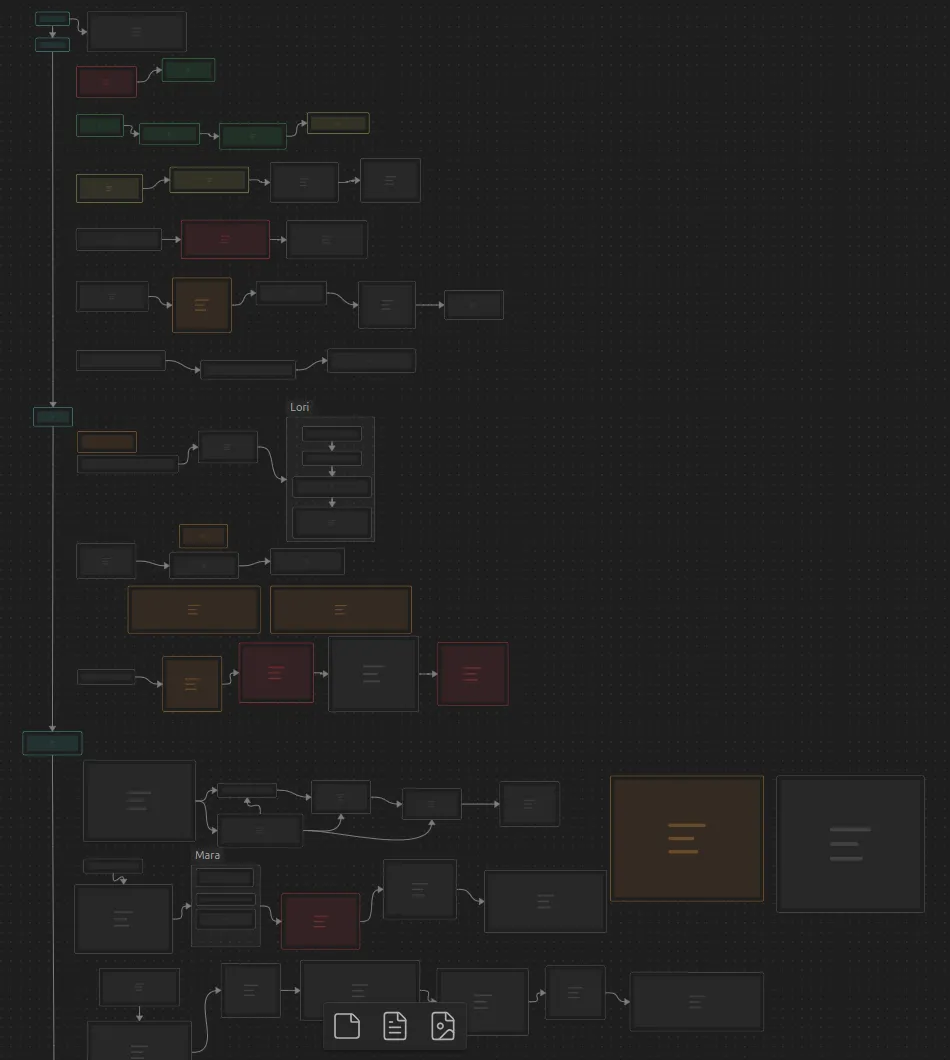
Scene Cards(see image at top of screen, an overview of scene cards for two or three chapters), the cause-and-effect trajectory laid out at a glance. Well, as he himself said, others were going to add to his work dialectically (thesis 👉 antithesis 👉 synthesis); and Lisa Cron, with herScene Cardartifact in the context of a cause-and-effect trajectory, the core of theNovel Blueprint, certainly has. TheScene Cardlooks something like this:
- I’m sure Lajos Egri would have loved
ALPHA POINT | Potatoes start falling from the sky |
|---|---|
{Albert} Storyline | Storyline Notes (keep other participating characters and storylines in focus) |
{Betty} Storyline | Storyline Notes (what do participating characters want?) |
{Candela} Storyline | Storyline Notes (why do they want that?) |
CAUSE | EFFECT | |
|---|---|---|
THE PLOT | WHAT HAPPENS Something happens | THE CONSEQUENCES After the smoke clears, we can see… |
THE THIRD RAIL | WHY IT MATTERS The Protagonist cannot allow that | THE REALIZATION The Protagonist sees now that… |
AND SO? I know, let’s go buy some supplies at the hardware store so that… |
- Manuscript scene instances (in various languages)
- SCENE: (link to scene edition instance en-US)
- SCENE: (link to scene edition instance es-AR)
-
The first thing you’ll fill in is what I call the scene’s
Alpha Point. It refers to the key role the scene will play in your novel’s external cause-and-effect trajectory. It’s related to action, to the seminal thing that happens. The question the Alpha Point must answer is, why is this scene necessary? What is its main job? This is what anchors the scene in your novel’s timeline. Every scene must have a concrete Alpha Point, and when you start a card for a scene this will often be the only blank you can fill in. - We can add all secondary characters whose
Storyline(sub-plot, character arc) threads through this scene, as well as additionalStorylineinstances also present.- 💻 Technical note 💻 (optional): If we have YAML properties in the text of say a markdown file that contains this table, those YAML properties can be invoked in many ways to, say, list all scenes in cause-and-effect order that contain any given
Storyline. Just an idea. For, say, Obsidian. Especially with its new Bases Notion-like note property based databases. Let me know if you implement something like that 😄.
- 💻 Technical note 💻 (optional): If we have YAML properties in the text of say a markdown file that contains this table, those YAML properties can be invoked in many ways to, say, list all scenes in cause-and-effect order that contain any given
- We then have a
CAUSEandEFFECTtable that has an initial plot point (action external to the Protagonist) forTHE PLOT(rising external conflict for this scene, something happens); along with movement in the internal struggle of the Protagonist forTHE THIRD RAIL. - Then the narrative moves like this in the scene:
CAUSEcolumnWHAT HAPPENS: What external action produces conflict for the Protagonist and any other participating Storylines?WHY IT MATTERS: How does the new situation affect the Protagonist?
EFFECTcolumnTHE CONSEQUENCES: The external action (plot) consequences that results from the action taking place in this scene, given everything (PLOT and Protagonist) in theCAUSEcolumn.THE REALIZATION: “For the third rail; it’s the internal change, the realization that the event triggers in the protagonist.”AND SO: a concrete action-based event that answers the question of what the protagonist is going to do in a following scene (cause-and-effect trajectory between scenes) based on the results (including theTHE CONSEQUENCESandTHE REALIZATION).
-
Keep in mind that every scene must produce a hard-won change, both externally and internally. If you’re writing a mystery, courtroom drama, or police procedural the same is true: every turn, even if it’s realizing that a promising lead fizzled, triggers an internal insight that helps the protagonist better understand what’s going on.
Example Scene Card from Story Genius, annotated by Lisa Cron
Section titled “Example Scene Card from Story Genius, annotated by Lisa Cron”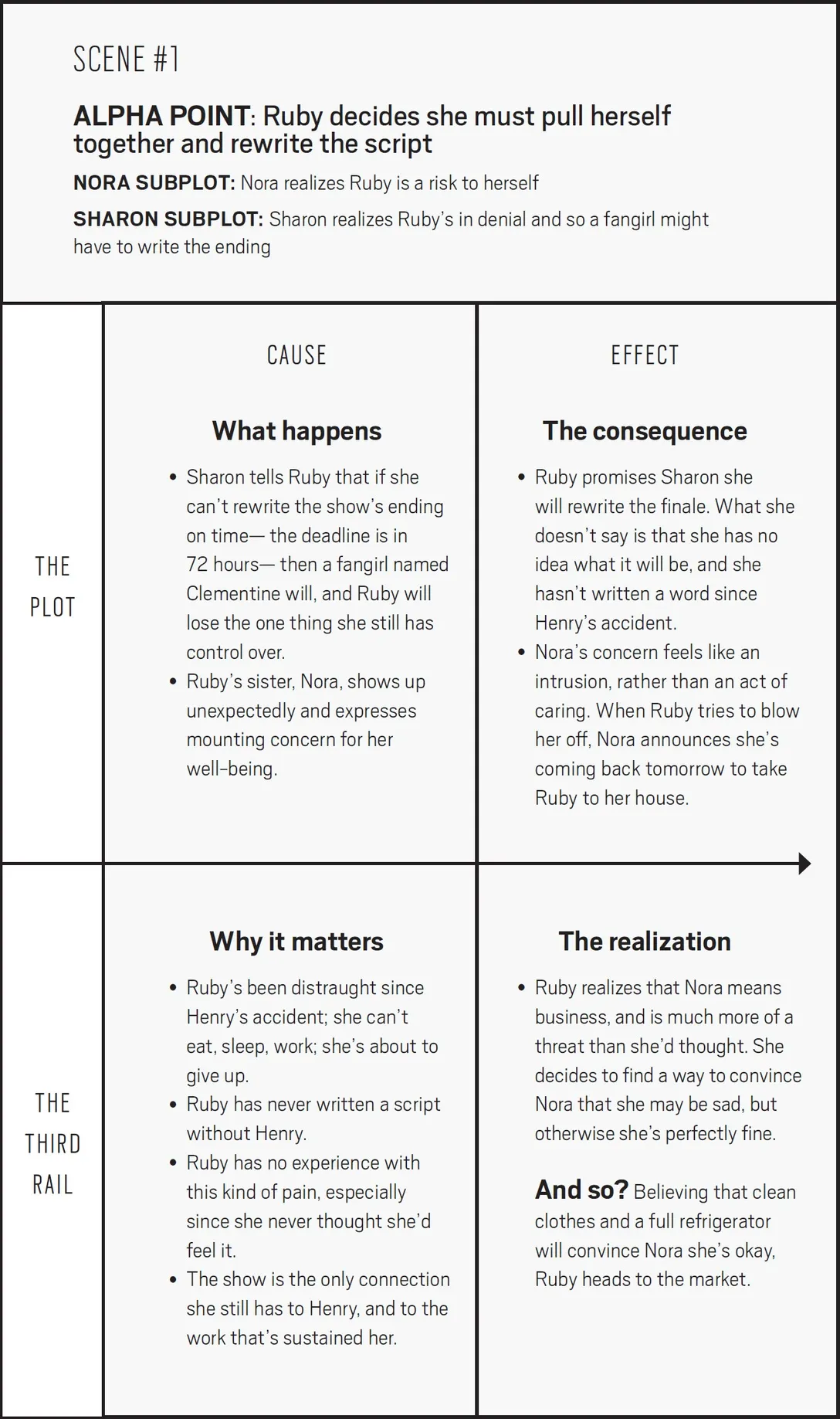
Although a lot happens in this scene, Jennie’s Alpha Point captures and concretizes the scene’s main point. Ruby is going to take action and write the script (or so she thinks). That is the point of this scene, the thing that needs to happen or the story can’t go forward. Because hey, otherwise for all we know Ruby might have sat in her house, sobbing, forever, and who wants to watch that?
The subplots are clear and concise and in a few words pinpoint Sharon’s and Nora’s roles in the scene, and what each learns from it, allowing Jennie to anticipate what they might do next. There may be times when there is no subplot to record, and that’s fine too.
The “What happens” reflects the initial action in the scene, the initial thing your protagonist must respond to. Sometimes this column will have only one event, sometimes several. Here, that initial action is the call Ruby receives from Sharon, followed by a visit from Nora.
“The consequence” within the scene is a direct result of “What happens.” Ruby changes before our very eyes: she is going to write the script, and to do that, she first has to placate Nora.
This change isn’t just surface action; it’s driven by “Why it matters” to Ruby: she is bereft, lost, at the end of her rope…but there is one thing that she still has control over that matters to her: having the final word on the show she and Henry created. That is something she will not give up.
Ruby’s “realization”—the thing that will drive the next action she will take—doesn’t have to do with the show, per se. It has to do with the only thing she thinks is standing in her way: Nora’s concern.
The And so? pinpoints exactly what Ruby’s next action will be, and why she thinks it’s a good idea. (Lisa Cron, Story Genius, Chapter 9)
Scene Card for Our Blueprint Opening Scene?
Section titled “Scene Card for Our Blueprint Opening Scene?”- So let’s get our Blueprint rolling out here, building upon the last Process Note, PraxisPoetica V. Step 2. The Pivotal Character, where we worked hard to determine the winning seminal
tickfor our novel, a single paragraph synopsis of the scene in which our story begins. The winner of theInciting Incident Candidate List. - I will present here the story
Scene Cardfor theOpening Sceneof the Novel we are presenting here in serial form, Wandering Into the Promised Land. Then please read the complete text of that scene, Desert Rider in Gray and see how the Scene Card works.
Scene #1 Desert Rider in Gray
ALPHA POINT | Aaron starts his life-changing journey to New York to begin his own independent life studying to become a Rabbi at the Jewish Theological Seminary, but he is ill-prepared, lacking the necessary resources needed for the journey |
|---|---|
Angel Storyline | The waitress; Angel in Creep (Radiohead), provides for Aaron |
Scene Timeline and Locations (I’m adding timeline locations to the scene cards 😄) | Leaves Los Angeles (the room he rented) (1967-08-22 15:00 hs) arrives at Halloran Springs Bowling (20:17 hs) goes into bowling alley for 15 mins (20:32 hs), leaves 30 mins. later (21:00 hs), gets to Church 10 mins later, sleeps about 4 hours on the stone steps, leaves on bike (1967-08-23 01:00 hs) |
CAUSE | EFFECT | |
|---|---|---|
THE PLOT | WHAT HAPPENS Aaron can’t find a place to eat his first meal on the road, because he can only pay with his Shell Credit Card and the few places still open don’t take credit cards (the 7-11 are closed). He finally finds a bowling alley that accepts credit cards, but as he goes in, he sees that you can’t actually use credit cards after 6pm. | THE CONSEQUENCES : So he gets a cheap piece of pie served to him by a kind and very encouraging waitress, just to survive the evening, and thinks that the Church he saw on the way in must have some place where he can lie down for a few hours.He slips out of the Bowling Alley without paying, but feeling very creepy about doing that. When he gets to the Church, it is closed with a padlock, so he sleeps on the stone floor at the entrance. |
THE THIRD RAIL | WHY IT MATTERS He feels bad because he hasn’t really earned enough cash to make the trip, hasn’t even mapped out the journey properly. And the temptation to just turn around and go back to LA and start over is just a whimpy lack of compromise pushing him towards not fulfilling his commitment. | THE REALIZATION Aaron can’t sleep long and realizes that the situation shows that inside he is already giving up, the lack of planning and resources show that inside he is giving up and assuming he won’t be able to do it. But he feels that this time, he needs to change, and can’t just give up, and that he must carry through on the commitment, and be stronger about things in general. To be independent you need planning and resources. You can’t travel from LA to NY without a route drawn on a map and without having enough cash to eat along the way; it’s only been a few hours since he left and already there’s this big problem? or is the whole thing just an exercise in self-sabotage? You want to go running back to Mummy Evy and Benji Dad? Aaron realizes he has to be strong, no way can he give in now; if he gives up now he won’t be starting Rabbinical School in New York, and he won’t be able to obtain a draft deferment. He can’t just give in. Not only now but from here on in. He has to stop doing this, and be stronger. Otherwise he won’t be able to start his new independent life. |
AND SO? Aaron gets back on his bike without waiting till morning, and promises himself that he will make a solid route on a map for the whole journey in the morning and make sure he has a good breakfast. Let’s do this! |
- Manuscript scene instances (in various languages)
- SCENE: (link to scene edition instance en-US)
- SCENE: (link to scene edition instance es-AR)
Complete Set of All Blueprint Artifacts
Section titled “Complete Set of All Blueprint Artifacts”-
We’ve already mentioned in another Note that many templates for common writer tools exist.
- (See for example the template for Scrivener by Gwen Hernandez: Using Scrivener with Story Genius)
-
But let’s list all artifacts required for the
Blueprintand understand together why we need them, whether we’re using a laptop or a pencil and a bound notebook. -
Obviously we need one folder in our writer tool for the
Manuscript(the actualSceneinstances making up the novel our readers are going to read) -
We need a folder (whether of a digital or cardboard variety) for the
Screen Cards in Development. Meaning an ordered, numbered set of Screen Cards reflecting our Cause and Effect Trajectory. Each scene card will link to the corresponding scene instance in the Manuscript. -
We can have another folder,
Random Screen Cards(following the Story Genius Nomenclature, or choose your own), which will be quick idea or flash generated scene ideas that barely have at least anAlpha Point; and haven’t been assigned yet to its place on the cause-and-effect trajectory. -
A
Charactersfolder holding character sketches, notes on character orchestration, and other artifacts we will soon present and explain in a forthcoming Note.- Within that folder, a
Protagonist(orPivotal Characteror whatever you wish to name it) sub-folder containing all the artifacts from our previous note PraxisPoetica V. Step 2. The Pivotal Character Who Must Win By Any Means Necessary
- Within that folder, a
-
A
Researchfolder for notes and links to historical and/or whatever other kind of research that is needed for the novel. For this novel, social movements of the 60’s, particularly, say, the occupation of Universities as part of the movement against the War(s) in Vietnam, materials on G.I. coffeehouses, etc., as well as on many other topics. Specifically the Fort Dix 38, in Trenton, New Jersey, in which the Jewish Radical Community participated. The origins of the JRC in Los Angeles Conference for Jewish Action, May,1969, helped a lot. -
A
World Buildingfolder if you feel the need for it. In the case of this novel, the hegemonies and counter-hegemonies are very much a part of (as they always are, in reality) each character. It is impossible for a character to exist without a world, and the world is not necessarily fantasy, it is the part of the character’s life without which they could not possibly exist. But if you feel the need for a folder to place all notes concerning hegemonies and counter-hegemonies, that’s fine. -
An
Idea Listfor ideas that just flash into your mind in the shower, while vacuuming the floor, or out for a walk. At least you’ll know where to find them; they should be kept in one place, and associated with the work you’re doing on the novel. -
Probably more stuff; later on, things related to writer tools; or publishing, like jacket covers, artwork, blurbs, whatever; events related to the launching of the novel, whatever. It’s always nice to have everything in one place.
So… this note covers a biggie topic… again, remember it’s all iterative and incremental, we’re not going to work through all this just once, or in any mechanical, rigid way… I hope.
Now, we’ve pretty much got what we need. When we feel we’ve got our Manuscript finished, we may want to take a vacation for a month and then perform a revision of the novel. But a revision is pretty much reading the manuscript and making a fresh outline (cause-and-effect trajectory sequence of Scene Cards) from the text, which can then be submitted to check-lists (basically, the same criteria we have already considered in making our initial set of Scene Cards in Development). And the work can be revised on many levels: scene by scene, on the basis of the work as a whole (inciting incident, rising action, etc. etc.)
Then there’s the question of formatting the novel. I’m going to use Atticus, where I can shove in a docx I can easily create from the markdown scenes (using Pandoc, in my case, otherwise there are many user-friendly alternatives).
I will be publishing Notes on all of these things, as I get there.
👉 I will be publishing another two or three notes, right away, however, in a few days. Because so far we’ve got the outline of what our Novel Blueprint is going to look like, and we’ve got the backstory scenes (from the last note on Pivotal Character as Premise development). These scenes may or may not appear in the actual novel (our Origin Scene does, and it’s also discussed in the last note, with a link to the scene manuscript). And we’ve got our generative Premise (Character + Conflict + Resolution) artifact. But how do we actually get started on our Blueprint development, and how can Lajos Egri and Lisa Cron help with that?
The 3 Notes that are coming soon:
- Rolling right out of the premise (from the third component, “Resolution”), surges the novel’s ending scene. Both Lajos Egri and Lisa Cron say: write your first scene (we got that) and your ending scene, first. So in a few days we’ll have a note on our novel’s ending scene.
- Then we’ll have a Note on what Egri calls
Character Orchestration, which Lisa Cron deals with in Chapter 14 of Story Genius “The Secret to Layering: Subplots, Storylines, and Secondary Characters”. We’ll look over the shoulder of Lajos Egri’s highly regarded playwright, Henrik Ibsen, as he spends a month riding on a train with the cast of his next screenplay. - Then, in a third note we need to complete in very short order, we’ll look at the cause-and-effect trajectory of the work as a whole, as it rolls right out of the
Premise, theProtagonist, theCharactersin dialectical conflict (Orchestration); and finally, in the all important (still looking at the cause-and-effect trajectory of the work as a whole)Conflictarena: gradual, dialectical (thesis-antithesis-synthesis)Transition; because the novel is driven by the Protagonist’s story of change: starting with thePoint of Attack(Inciting Incident, Origin Scene…), journeying through all the rising and foreshadowing conflict scenes, each with a pinch of transition, each with a pinch of crisis, climax and resolution, change; to arrive finally at the ending sequences, evidenced in the scenes ofCrisisandClimax; and finalizing atResolution; in the ending scene.- We can understand clearly now, why we need to do the
Origin Scenefirst, theticksleading up to theOpening Scene, theOpening Sceneitself; and then theEnding Scene. After which we can develop the cause-and-effect trajectory in-between all that, right? OK, that’s what we’re talking about. In the next three notes, very soon.
- We can understand clearly now, why we need to do the
🔥 From that point on, I will mostly be publishing scenes 🔥 Yeah!
© Victor Opas Kane. Some rights reserved. CC BY-NC-ND 4.0 International License